
Remote Work Estonia: My One-Month Digital Nomad Guide to Europe’s Digital Haven
- January 27, 2026
- 0
The decision started the way most modern moves do, with a late-night rabbit hole and a single goal, find a place that makes remote life feel easy, not

The decision started the way most modern moves do, with a late-night rabbit hole and a single goal, find a place that makes remote life feel easy, not
Disclaimer: This guide shares practical travel, admin, and budgeting lessons from a one month stay, it is not legal or tax advice. Visa rules and taxes change, always verify details with official sources or a qualified professional.
The decision started the way most modern moves do, with a late-night rabbit hole and a single goal, find a place that makes remote life feel easy, not chaotic.
The traveler behind this guide had done the usual “fast Wi-Fi, nice cafes, good value” loop across a few countries.
But this time, the mission was more specific: a country where digital systems are built for everyday life, where a newcomer can get set up quickly, and where the scenery does not feel like a backdrop, it feels like a reset button.
That is exactly where the phrase remote work Estonia digital nomad first entered the plan, not as a trend, but as a filter. Estonia kept appearing for the same reasons, high quality of life and safety, widespread English proficiency, and a reputation for high-speed internet infrastructure that is not just marketing.
The reality on the ground matched the hype more than expected, especially in the first week, when the practical details either make or break a one-month stay.
What surprised the traveler most was the emotional contrast, Tallinn can feel futuristic in the morning and medieval by sunset, and nature is always close enough to matter.
Estonia is small in the best way for a 30-day experiment, you can build a stable routine, then break it on weekends without losing time to long transfers.
For most people, the legal question is the one that decides everything. Navigating the visa application process can feel like walking into a maze of vague rules, but Estonia’s guidance is unusually direct if someone reads carefully and prepares early.
Two concepts dominate the conversation: the Estonian Digital Nomad Visa (DNV) and the e-Residency program. They are often confused, and that confusion costs people time.
The simplest way to frame the e-Residency vs. DNV Distinction is this: one is about transnational digital identity and running a business online, the other is about legal stay and work authorization while physically in Estonia.
Here is a quick comparison that keeps the most common misconceptions out of the way.
| Topic | Digital Nomad Visa | e-Residency |
|---|---|---|
| What it is | A visa route for location-independent work while staying in Estonia temporarily | A government-issued digital identity for online authentication and signing |
| Physical stay | Supports temporary stay (typically up to 1 year under standard visa rules) | e-Residency is not a visa, it provides no physical residency rights |
| Who it fits | Remote employees, freelancers, business owners working for foreign entities | Entrepreneurs who want to manage EU company online and handle admin remotely |
| Market angle | Can support Schengen Area travel rights under standard Schengen rules during the valid period | Helps with access to EU single market via company operations, not personal mobility |
| Core takeaway | A legal “being there” solution | A borderless business management solution |
A practical strategy many people use is holding both DNV and e-Residency, one to live in Estonia temporarily, the other to operate an EU-facing business structure online.
This is the checklist-driven part. The traveler’s experience was that Estonia’s requirements are not hard, they are precise. Precision is friendly if someone prepares.
Step 1: Choose the correct visa type for the plan
Step 2: Gather proof and supporting documents
This is where most delays happen, because people assume “a job + laptop” is enough. Estonia asks for proof of remote work, and the evidence must be clean and consistent.
Step 3: Submit through an official route
Applicants can apply through an Estonian representation, in person in Estonia at a Police and Border Guard office, or via a VFS office that handles submissions in certain countries.
(That is why many people see VFS Global (Visa application center) mentioned in planning threads.)
Step 4: Wait for processing
A common expectation is a 15-30 day visa processing time, and official guidance often frames it as “up to 30 days,” so it is smart to build buffer time.
Estonia is explicit about the financial threshold and history:
This is the easiest section to get wrong because “remote” can mean many structures.
These documents are essentially a story, Estonia wants to see that the story is coherent across contracts, statements, and the timeline.
As commonly referenced in official-style summaries:
For submission routes and where to go, official guidance emphasizes using recognized channels, including Police and Border Guard offices and VFS where applicable.
Taxes are where good trips get messy, so the traveler treated this as “understand the logic, then verify with a pro.”
The core concept is the 183-day tax residency rule. Estonia’s own guidance explains that an individual can be considered a tax resident if they stay at least 183 days over 12 consecutive calendar months.
What happens if someone stays less than 183 days?
In many cases, they are less likely to become a tax resident based purely on days, but tax residency is not only about days in every situation, so professional advice is still smart for US taxpayers or complex setups.
What are the tax implications for DNV holders after 183 days?
Crossing the threshold can shift the analysis toward resident taxation concepts, including the idea of worldwide income taxation for residents in many systems.
About rates, it is important to be current. Many older posts reference a 20% flat income tax rate, but Estonia has implemented changes and the flat rate has been discussed as 22% from 2025 in several official and professional summaries.
For entrepreneurs, Estonia is famous for the corporate model often summarized as 0% corporate tax on reinvested profits, with taxation triggered on distribution rather than retention.
Also note that double taxation treaties may apply depending on the person’s home country, which is why US-based nomads should not rely on generic advice.
Estonia rewards people who choose a base intentionally. The traveler’s approach was to start in the capital for momentum, then rotate to smaller places for focus and recovery.
Tallinn (Capital city, tech hub) is where the month began, and it is the best place to land if someone wants “easy mode.” The city’s structure supports routine fast: public transport, walkability, and a dense cluster of cafes and coworking options.
The daily contrast is real, a morning sprint in a modern workspace, then a sunset walk through Tallinn Old Town (UNESCO World Heritage Site) without needing a long commute. It does not feel like a museum city, it feels lived in.
Cost of living Tallinn vs. Tartu is noticeable, Tallinn is generally higher, especially in peak seasons and in the most popular neighborhoods.
For one month, the traveler treated accommodation like a productivity tool, not a travel luxury. The most common pattern is:
How to find a short-term apartment in Tallinn?
The practical answer is to book a short “landing week” first, then extend or switch once the best neighborhood becomes clear.
What is the best neighborhood in Tallinn for a one-month stay?
Kalamaja (Trendy district in Tallinn) tends to win for many nomads because it is walkable, creative, and social without being loud.
Tallinn is a strong coworking city. The traveler rotated between:
The hidden advantage is not the desk, it is the calendar. Tallinn’s startup scene regularly hosts startup networking events, and Telliskivi Creative City events are a reliable way to meet builders, designers, and founders without forcing the interaction. For newcomers, Telliskivi Creative City (Tallinn) also works as a “third place,” you can show up, do a few hours of work, and still feel part of the city.
Tallinn is where Estonia’s digital society vibe is easiest to feel. Payments are frictionless, transport is simple, and errands do not steal the day. For quick rides, Bolt (Ride-hailing) is the common default. For money management, Wise (Fintech) is frequently used by travelers to reduce conversion pain.
The traveler also noticed a cultural detail that matters, the city is friendly but not overly chatty. That can feel cold in week one, and peaceful by week three, depending on personality.
Tartu (University city, cultural center) feels like Estonia exhaling. It is smaller, calmer, and for many people it is the place where deep work becomes easier. The traveler planned “a weekend,” then nearly stayed longer, because the city has a young energy without the capital’s pace.
The University of Tartu is not just a landmark, it shapes the rhythm, more cafes, more student life, more events, and a stronger sense of community for introverts who still want social options.
Tartu is often more affordable for medium stays, and hosts who cater to visiting academics and international students tend to understand quiet work needs.
How to find rentals on kv.ee or city24.ee?
In Tartu, the practical tip is to filter for furnished units and be ready to message quickly, good listings move fast.
The traveler’s main anchors:
Aparaaditehas is especially useful because it is a hybrid space, work corners, creative studios, and casual food options. For newcomers, official-style welcome services are also more visible here, including International House of Tartu and the Tartu Welcome Centre, which can be surprisingly helpful for settling questions that do not feel worth a full government appointment.
Tartu also hosts a strong startup culture, and sTARTUp Day (Business Festival, Tartu) is the kind of event where a visitor can meet serious people without heavy networking pressure.
Tartu’s charm is routine-friendly, riverside walks, parks, and cafes where staying two hours does not feel like a crime. If Tallinn is “build your network,” Tartu is “build your system.”
Pärnu (Summer capital, coastal town) is the part of the month that felt like a reward. The traveler spent a full week there to decompress, and the result was better work, not less work.
Pärnu “summer capital” is not just branding, in warm months the city becomes a beach-first lifestyle with enough infrastructure to keep projects moving.
This is where the planning matters most. Seasonal accommodation costs swing hard. It is common to see higher prices in summer and significantly lower rates in winter, which is why the phrase average monthly rent in Pärnu in summer vs winter becomes a real budget lever for anyone with flexible timing.
Is Pärnu a good city for digital nomads?
Yes, with one condition, it depends on season and social expectations.
Smaller city, smaller scene, but still real:
People here often connect more naturally through routines, morning coffee, walks, and wellness activities, rather than formal events.
Pärnu works because nature is close. A day trip to Soomaa National Park can feel like a full reset, and it balances out screen-heavy weeks. For longer breaks, Saaremaa (Largest island in Estonia) is a strong long-weekend option if someone wants quiet roads and coastal scenery.

The traveler’s rule was simple, win the first 48 hours, and the whole month becomes easier.
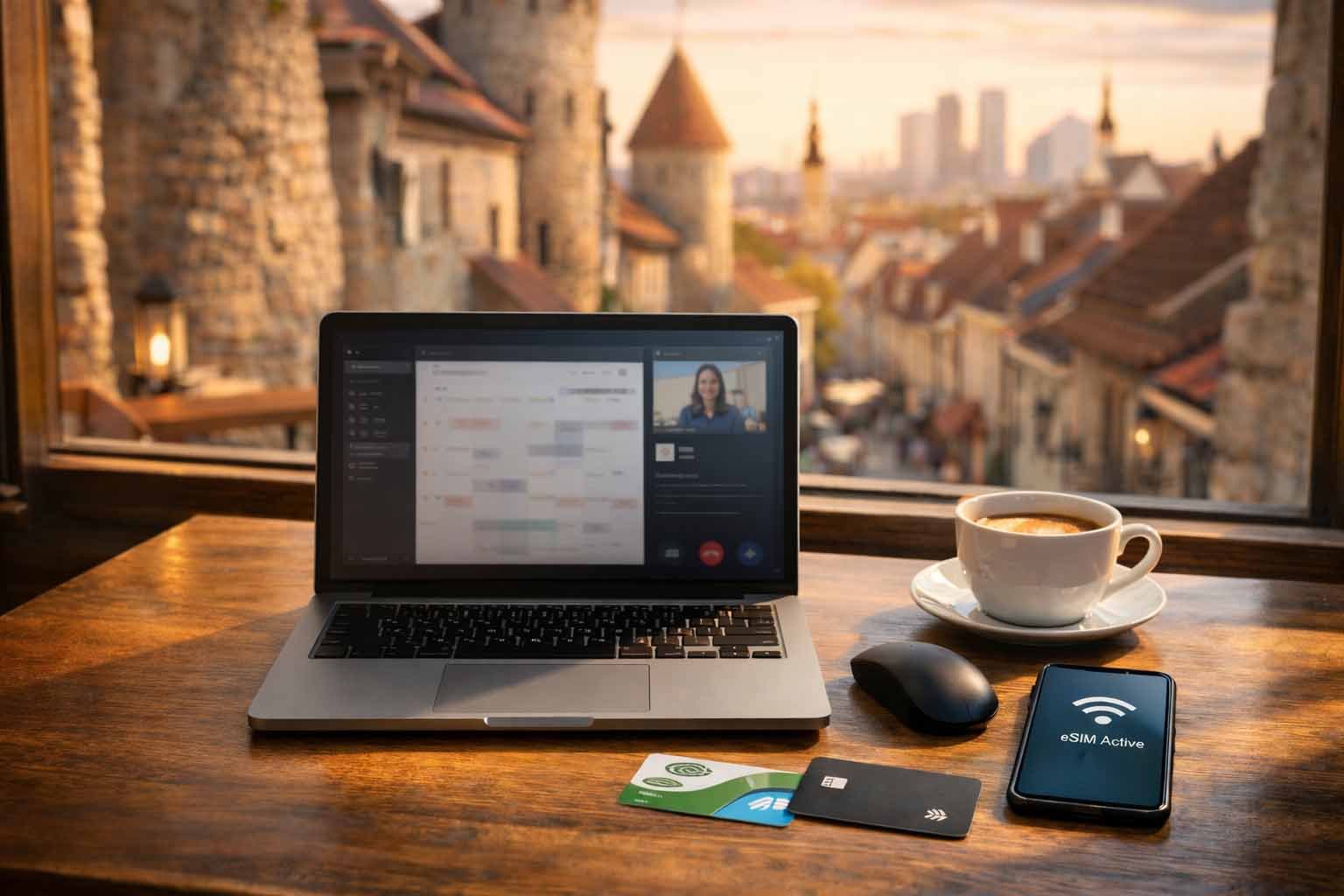
Arriving at Lennart Meri Tallinn Airport (TLL) is straightforward, it is compact, and it does not feel chaotic. The first move is connectivity.
How to buy a SIM card in Estonia?
A common option is a prepaid Kõnekaart SIM card, usually easy to find at R-Kiosk convenience stores. Estonia’s main providers include Telia, Elisa, Tele2 mobile providers, and travelers can also find eSIM options in Estonia depending on device and provider. The traveler’s approach was to prioritize coverage and easy top-ups over chasing the cheapest plan.
Public transport in Estonia is the kind of system that makes a visitor feel competent fast.
For Tallinn, the Ühiskaart public transport card is the classic option, and top-ups are commonly managed through the pilet.ee transport portal. Tallinn’s official guidance also notes you can load value online and use contactless payment options in certain validator contexts.
How do I pay for the bus in Tallinn without an Ühiskaart?
Using a contactless bank card for transport is often the fastest option if someone does not want another card in the wallet.
In Tartu, contactless payments are also supported, and the card ecosystem connects to the same “pilet” style platforms.
How much does a 30-day bus pass cost in Tallinn?
A common reference point in official city guidance is a 30-day ticket at 30 Euro (€).
That single number can simplify the whole month, because it lets someone stop thinking about per-ride friction.
For a one-month stay, intercity travel is where Estonia becomes fun, because distances are short.
How to travel between Tallinn, Tartu, and Pärnu?
The traveler used buses when timing mattered and trains when the ride itself was part of the break.
A month is long enough to feel lonely if someone does not design community on purpose. Estonia can be especially tricky here, not because people are rude, but because the reserved Estonian social culture means strangers often give space by default.
The easiest way to avoid “week one loneliness” is to join communities early:
These groups also answer practical questions quickly, including neighborhood advice, SIM tips, and event recommendations.
In Tallinn, the traveler treated Meetup.com and InterNations as a calendar, not a social gamble. The trick is consistency, show up weekly, not once.
Telliskivi is the standout location for organic networking, especially for creatives and founders. If someone is looking for “people building things,” the odds are better there than in a random bar.
After 30 days, the verdict was clear, Estonia is one of the easiest places in Europe to live a structured remote month, but it is not a “party nomad” destination unless you build that scene yourself.
A realistic budget depends on season and rent style, but the biggest driver is accommodation. The traveler’s “comfort but not luxury” model was:
Yes, if someone wants quiet and low costs. The tradeoff is social energy, it gets calm fast in colder months, but that calm is exactly why some people choose it, plus seasonal accommodation costs can drop significantly.
Based on the traveler’s experience and the general feel of public spaces, yes. Estonia’s high quality of life and safety shows up in simple moments, walking home at night, taking public transport, and not feeling on edge in everyday routines.
Yes. Tartu’s ticketing supports contactless card payment options, which makes it easy for visitors who do not want to manage a separate card immediately.
Kalamaja is a strong default because it blends cafes, creative spaces, and walkability. For quieter budgets, other residential areas can work better, but Kalamaja is the easiest “first month” choice for many newcomers.
The headline concept is the 183-day threshold used in Estonia’s tax residency logic, and the possibility of different treatment once someone becomes resident under local criteria. Estonia’s own explanations reference 183 days over 12 consecutive calendar months as a key rule.
Because US tax is complex and global, the traveler’s strong recommendation is to consult a professional, especially if the stay extends or if income flows through a company.
Yes, and it can be a smart combo. The practical use case is operating an EU business presence via e-Residency while using the visa route for legal temporary stay in Estonia.
No. It is designed as a temporary arrangement and is not positioned as a residency pathway, so planning should treat it as a time-limited solution.
It can take time. The traveler noticed that trust builds slowly, but once it builds, it is real. The most effective method was repetition, same cafe, same coworking, same hobby group, and letting familiarity do the work.
The key distinction is that the nomad route is framed around working for a foreign entity or foreign clients. A common approach is to use e-Residency to manage an Estonian company online while the individual’s remote work eligibility remains tied to foreign-based activity.
Joonas Vaher is a remote-work writer focused on practical digital nomad systems, visas, and real-world logistics across Europe. Published by Ahmed Saeed.