
Freelancer taxes Italy: simple first-year checklist
- December 12, 2025
- 0
Disclaimer: This guide is for general information only and does not replace personalised tax or legal advice. Always verify your situation with Agenzia delle Entrate, INPS or a

Disclaimer: This guide is for general information only and does not replace personalised tax or legal advice. Always verify your situation with Agenzia delle Entrate, INPS or a
Disclaimer: This guide is for general information only and does not replace personalised tax or legal advice. Always verify your situation with Agenzia delle Entrate, INPS or a qualified commercialista.
When I opened my first invoice as a freelancer in Italy three years ago, I had absolutely no idea what I was doing with my taxes.
The confusion around first year freelancer tax obligations nearly paralyzed me should I open something called a partita IVA? What about tasse e contributi per professionisti senza albo? Would I owe thousands immediately?
After stumbling through forms, late-night Google searches, and one embarrassing visit to the local tax office, I realized something important: nobody explains this stuff in plain language.
So I created this simple checklist a guida semplice alle tasse per chi lavora in proprio that I wish I’d had back then.
This article walks through everything from registration to year-end filing, using my real experiences (including the mistakes) to help you avoid the panic I felt.
Let me start with what income tax for freelancers in Italy actually covers.
Whether you’re designing websites, writing content, consulting, or running any professional service even side gigs done from your bedroom the Italian tax authority considers this taxable freelance activity.
It doesn’t matter if your client is around the corner or halfway across the world.
The Italian self-employment tax rules differ fundamentally from employee taxation. As an employee, your employer withholds taxes automatically.
As a freelancer, you’re responsible for everything: calculating what you owe, setting money aside, and making payments on schedule. Nobody does it for you.
At the heart of the system sits IRPEF Italy’s progressive income tax.
The IRPEF brackets for self-employed workers apply differently depending on your total annual income and which tax regime you choose. For instance, under the standard system, rates climb progressively as your income increases, while under the simplified regime, you might pay a single flat rate instead.
Here’s what many first-timers miss: when Italians talk about tasse e contributi per professionisti senza albo, they mean both income tax AND contributi previdenziali (social security contributions).
These are separate obligations. Your income tax goes to the state for public services, while your contributions build up pension rights through INPS. Both hit your bank account, but they serve different purposes.
I’ll never forget opening my first tax assessment letter. The numbers looked enormous compared to what I’d actually received in my bank account.
So let me break down how does self-employment tax work in Italy using my first-year figures as an example (I’ve rounded for simplicity).
Say you invoice €30,000 across your first year. That’s your gross income. First, you’ll owe income tax based on Italian tax rates for freelance income.
If you’re under the simplified flat regime, you might pay around 15% (though the actual calculation involves coefficients more on that later). That’s roughly €4,500 in income tax.
Next come INPS contributions typically around 25-26% of your income if you’re under gestione separata. On €30,000, expect approximately €7,500-7,800 in contributions. Already you’re looking at over €12,000 in total obligations.
This is the difference between gross and net freelance earnings that shocked me. To calculate net income after Italian taxes properly:
That’s roughly 59% of what you invoiced. The remaining 41% goes to taxes and contributions.
This is why previsioni di imposta per lavoratori autonomi (tax forecasting for autonomous workers) matters so much.
Using simple calcolo imposte per lavoratori freelance tools even basic spreadsheets lets you predict these obligations monthly instead of facing a shocking bill in June.
Since I work remotely and occasionally move between cities, I learned some practical tax tips for digital nomads in Italy.
The key principle: your tax residency is where you’re habitually present, not where you happen to work on any given Tuesday. If Italy is your primary base (more than 183 days per year), you’re tax resident here and owe Italian taxes on worldwide income.
The surprise for many remote workers comes from social security contributions for freelancers in Italy. These aren’t discretionary.
Even if you’re earning modest amounts or working part-time while traveling, once you’re registered and operating, INPS contributions become mandatory. Budget for them from invoice number one.
One critical disclaimer: I’m sharing what I learned through my own journey and research, but this is a practical checklist, not legal advice.
Tax rules change, individual situations vary wildly, and mistakes can be costly. Always double-check specific details with Agenzia delle Entrate directly or with a qualified commercialista before making major decisions.
Let me walk through my actual timeline as a step-by-step guide to registering as a freelancer. It started three months before I sent my first invoice.
Month -3: I decided to formalize freelance graphic design work I’d been doing informally. First question: what exactly is my activity? I needed to define it clearly because Italian bureaucracy demands precision.
Month -2: Research phase. I spent evenings figuring out cosa devo fare il primo anno da freelance: which forms to file, what codes to pick, whether I needed additional registrations. For purely intellectual freelance work (writing, design, consulting), I didn’t need camera di commercio or registro imprese registration. Those mainly apply to businesses with physical stores, inventory, or certain trade activities.
Month -1: Document preparation. I gathered my identity documents, tax code (codice fiscale), and drafted a simple business plan to clarify my target market and expected income range.
Month 0: Official registration. I filed the startup paperwork with Agenzia delle Entrate to open my partita IVA.
This timeline assumes a straightforward intellectual service. If you’re opening something more complex say, importing goods or running a registered business add extra weeks for camera di commercio procedures.
Here’s opening a partita IVA step by step in plain language. The partita IVA is your VAT number, but it’s much more than that it’s your identity as a professional taxpayer.
Step 1: Decide your activity and check if you truly need a partita IVA. If you’re doing occasional collaboration work under ritenuta d’acconto arrangements, you might not need one immediately. But for regular, independent work, you’ll need it.
Step 2: Choose your codice ATECO (activity code explained in the next section) and tax regime (forfettario or ordinario).
Step 3: File form AA9/12 (for individuals without a VAT number) or equivalent online through your Agenzia delle Entrate profile. You can do this yourself online or through a commercialista.
Step 4: Within days, you receive your partita IVA number usually identical to your codice fiscale but used in different contexts.
Step 5: Set up PEC (certified email) for official communications.
The difference between being an employee and having a partita IVA for freelance workers is profound. As an employee, someone else handles payroll, withholds taxes, and manages compliance. With a partita IVA, you’re the business owner, invoice issuer, and tax accountant rolled into one.
What is the minimum income for opening a partita IVA? Technically, there’s no legal minimum. I’ve seen people open one expecting just €5,000 in the first year. However, practical reality matters: if your expected income is very low, the administrative burden and minimum INPS contributions might exceed your earnings. Many people still open one anyway because they expect growth, want to work legally, or need it to invoice specific clients.
Your codice ATECO is a six-digit activity classification code that tells authorities exactly what you do. It’s not just bureaucratic trivia it affects your tax rate, contribution obligations, and which deductions you can claim.
When choosing the right ATECO code for freelancing, start at the Agenzia delle Entrate website or ISTAT database. Here are three real examples:
For digital services, the question becomes quali codici ATECO usare per lavoro freelance online. If you do web development, 62.01.00 fits perfectly.
But what if you’re a content creator who writes, designs, and manages social media? You might need a broader code like 73.11.02 (consulting) or even 74.90.99 (other professional activities).
My mistake in year one: I picked a code that was slightly too narrow. When my work expanded into adjacent services, I should have chosen a broader classification from the start. Changing your ATECO code later is possible but adds paperwork.
Your choice also impacts volume d’affari annuo calculations because different activities have different redditività coefficients under regime forfettario (we’ll get to that soon). A code with a higher coefficient means more of your turnover counts as taxable income.
Quick checklist (mini guida fiscale per la prima partita IVA style):
From day one, you need PEC (posta elettronica certificata) certified email that has legal value equivalent to registered mail. Think of it as your official postal address in digital form.
I use my PEC for:
Cost is minimal usually €5-10 per year from authorized providers. Set it up before you officially start because many authorities won’t accept standard Gmail or Outlook addresses for official matters.
Once registered, you’ll interact with several online portals regularly. The main one is Agenzia delle Entrate’s Fisconline area, where you’ll file declarations, check your tax position, and make F24 payments. INPS has its own portal for contributi previdenziali.
Get familiar with these interfaces early they’re intimidating at first but become routine.
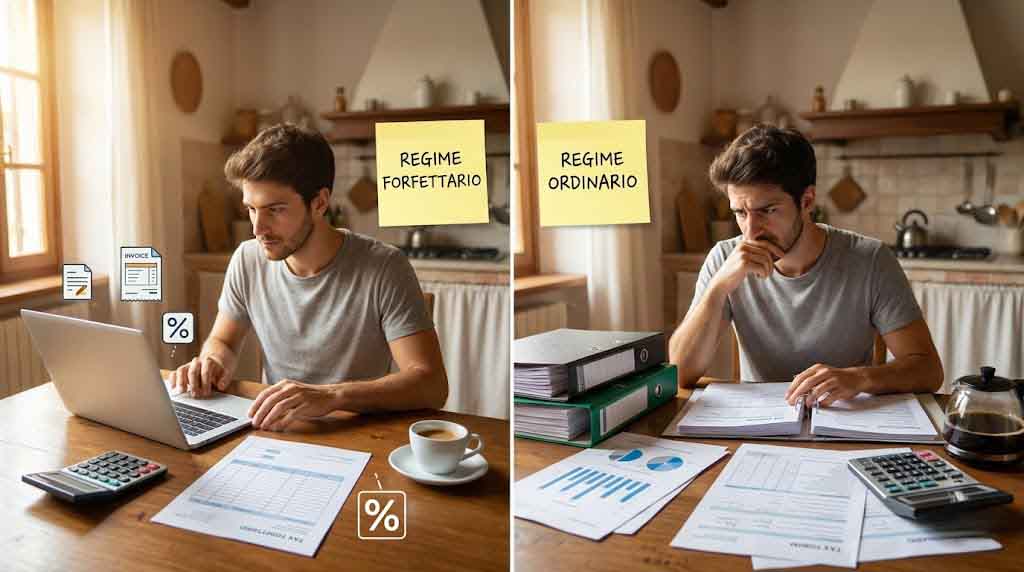
Imagine sitting across from a friend at a café, and they ask what regime forfettario means. Here’s what I’d say:
It’s a simplified tax regime for small freelancers designed to cut bureaucratic overhead. Instead of tracking every expense, proving every deduction, and calculating multiple tax obligations, you pay one flat substitute tax rate. In 2024, that rate is typically 15% (or 5% in your first five years under certain conditions).
The system works through coefficients. Italy says, “For your type of activity, we assume your actual profit is X% of your gross revenue.” Then they tax only that assumed profit. For example, if you invoice €30,000 and your redditività coefficient is 78%, your taxable base becomes €23,400. At 15%, you’d owe €3,510 in income tax.
This simplified tax regime for small freelancers means:
The flat-rate tax for solo professionals in Italy appeals to beginners because it’s predictable. You can calculate your obligation with a simple spreadsheet.
The big constraint is the limite di ricavi regime forfettario currently €85,000 in annual revenue. Go beyond this threshold, and you’re kicked out of the simplified regime.
Other key limits:
The coefficienti di redditività vary by codice ATECO:
This is why your codice ATECO choice matters. A higher coefficient means more of your volume d’affairs annuo gets taxed, even though the flat rate stays at 15%.
The regime ordinario is the standard system that all businesses can use. Under this regime, you:
The difference between regime ordinario and regime forfettario is like comparing a detailed ledger to a back-of-napkin calculation.
Ordinario gives precision and the ability to deduct every legitimate expense (office rent, equipment, travel, professional development). Forfettario gives simplicity and predictability.
Who qualifies for the forfettario scheme? Any sole proprietor under the revenue and eligibility limits mentioned earlier. But who should choose ordinario despite higher complexity?
Consider ordinario if:
From my experience, can I change tax regime after the first year? Yes, but with restrictions. You typically communicate your choice by specific deadlines, and some changes can only happen at year-end.
If you exceed the forfettario limits mid-year, you might be forced into ordinario automatically.
The flat-rate tax for solo professionals in Italy remains the most popular choice for beginners because the administrative burden is dramatically lower, even if you might pay slightly more tax in some scenarios.
IVA (Imposta sul Valore Aggiunto) is Italy’s value-added tax essentially a consumption tax added at each stage of production. Standard rate is 22%, though reduced rates exist for specific goods and services.
As a freelancer, VAT registration for Italian freelancers happens automatically when you open your partita IVA under regime ordinario. However, under regime forfettario, you generally don’t charge VAT. This confuses many newcomers.
Do freelancers pay VAT on all invoices? It depends entirely on your regime:
When clients are businesses, they usually prefer invoices with VAT because they can deduct it. When clients are consumers, they don’t care they pay the total either way.
How often do I need to file VAT returns in Italy? Under ordinario, typically quarterly or annually depending on your turnover. Under forfettario, you don’t file VAT returns at all because you’re outside the VAT system.
Every business invoice in Italy must include:
Since January 2019, fatturazione elettronica (electronic invoicing) became mandatory for almost all transactions. You can’t just email a PDF anymore invoices must pass through the Sistema di Interscambio (SDI), the government’s digital hub.
Here’s how it works:
Your PEC (posta elettronica certificata) receives these notifications. Even if your client is a private individual without a PEC, SDI provides a fallback mechanism but proper registration makes everything smoother.
I use invoicing software that handles XML formatting automatically. Manual XML creation is technically possible but absolutely impractical.
Here’s where things get interesting. Ritenuta d’acconto literally means “withholding tax,” and it appears frequently in freelancer-client relationships.
Example: You invoice a company €1,000 for consulting work. Instead of paying you €1,000, they withhold 20% (€200) and send it directly to the tax authority on your behalf. You receive only €800. That €200 becomes a credit against your final tax bill.
The ritenuta d’acconto mechanism exists so businesses can act as tax collectors, ensuring freelancers don’t skip tax payments. It’s common for ritenuta d’acconto for collaborations between Italian businesses and partita IVA holders under certain circumstances.
The differenza tra ritenuta d’acconto e partita IVA often confuses people. They’re not alternatives they’re separate concepts.
Your partita IVA is your tax identity; ritenuta is a payment mechanism. You can have a partita IVA and still receive payments subject to ritenuta d’acconto.
Key note: Under regime forfettario, you’re often exempt from ritenuta d’acconto. You must indicate this exemption on your invoices.
Local taxes for professionals in Italy (addizionale comunale and regionale) can also interact with withholding, though these are typically calculated at year-end rather than withheld on individual invoices.
Can I work with foreign clients as an Italian freelancer? Absolutely I do it regularly. However, the invoicing rules shift depending on where your client is located and whether they’re a business or consumer.
For EU business clients (B2B), you typically apply the “reverse charge” mechanism: no Italian VAT, but you must note that VAT is due in the client’s country. For non-EU clients, different rules apply based on the service type.
How to declare income from platforms and marketplaces (like Upwork, Fiverr, or App Store) deserves special attention.
These platforms often issue annual statements. You must report this income when filing your tax return, even if the platform withheld fees or foreign taxes.
When it’s time to report freelance income to the tax office, all income countsdomestic and foreign. If you worked through a US platform and received payment via PayPal or bank transfer, that’s still Italian taxable income for a tax resident.
Which expenses are deductible for remote workers? Under regime ordinario, you can deduct:
Under regime forfettario, remember: you can’t itemize deductions. The coefficients already assume average business costs.
INPS (Istituto Nazionale Previdenza Sociale) manages Italy’s social security and pension system. INPS contributions for freelancers are mandatory payments that build your pension credits.
Here’s what many first-timers misunderstand: social security contributions for freelancers in Italy aren’t taxes in the traditional sense.
They’re not funding government operations. They’re going into your personal pension pot. When you retire, your pension amount depends partly on how much you contributed throughout your career.
The contributi previdenziali concept works like this: each year, a percentage of your income (typically 25-26% under gestione separata) goes to INPS.
Think of it as forced retirement savings. Yes, it hurts your monthly cash flow, but it ensures you’re not destitute at 70.
Unlike tasse e contributi per professionisti senza albo that fund public services, these contributions are specifically earmarked for your social security benefits: pension, maternity/paternity leave, sickness coverage (limited).
Most freelancers without a professional association (albo) fall under gestione separata INPS. This covers:
Your codice ATECO and activity type determine which system applies. Some regulated professions (architects, engineers, accountants) must join their cassa previdenziale professionale instead separate pension funds managed by professional associations.
If you’re a graphic designer, you’re probably gestione separata. If you’re a certified accountant, you join the accountants’ cassa. Check your specific situation during registration because the contribution rates and rules differ.
Learning how to pay INPS contributions online was initially frustrating until I understood the system. Contributions are typically paid quarterly or monthly using F24 forms through your bank’s online portal or the Agenzia delle Entrate website.
You’ll receive payment deadlines throughout the year. Miss them, and interest penalties accumulate quickly.
To come verificare i versamenti dei contributi INPS (verify contribution payments are recorded):
I check quarterly to ensure nothing was lost in the system. Mistakes happen sometimes a payment doesn’t register properly. Catching errors early prevents major headaches years later when you’re applying for benefits.
Linking this back to previsioni di imposta per lavoratori autonomi: budget your tax and contributions together. In my spreadsheet, I set aside approximately 40% of every invoice roughly 15% for income tax, 25% for INPS, plus a buffer for local surcharges.
Let me walk through how to estimate tax in the first freelance year using a realistic scenario.
Assume you expect €25,000 in gross revenue under regime forfettario with a 78% coefficient (intellectual services):
Step 1: Calculate taxable income: €25,000 × 78% = €19,500
Step 2: Apply flat tax rate: €19,500 × 15% = €2,925 income tax
Step 3: Calculate INPS contributions: €25,000 × 25.72% = €6,430
Step 4: Add estimated local surcharges: ~€200-300
Total annual obligation: ~€9,655 (or about 38.6% of gross)
How much to set aside for taxes each month? Based on this, I’d recommend 40% of every invoice. If you invoice €2,000, immediately transfer €800 to a dedicated savings account.
This prevents the nightmare scenario where June arrives (when first major payments are due) and you’ve spent everything.
The calcolo imposte per lavoratori freelance tools I use are honestly just Google Sheets. I track monthly:
Nothing fancy, but it prevents surprises.
Here’s a simplified overview of tax deadlines for Italian freelancers:
June 30: Major deadline for:
November 30:
Throughout the year:
Let me explain acconto imposte and saldo imposte because they confused me initially:
The Italian system requires you to prepay current-year taxes based on what you owed last year. These are “acconti” (advances). Then, when you file your return the following year, you calculate what you actually owe. If you prepaid too much, you get a credit. If you underpaid, you pay the “saldo” (balance).
For quarterly tax payments for self-employed in Italy: if you’re in regime ordinario with VAT obligations, you may have quarterly filings. Under forfettario, your main obligations are the June and November deadlines.
What happens if I miss a tax deadline in Italy? You can often still pay with penalties usually a small percentage increases for each day late. For major delays (months), penalties escalate significantly.
The system allows “ravvedimento operoso” (voluntary correction) where you calculate the penalty yourself and pay it along with the late amount.
I missed a November deadline once by a week. The penalty was about 1.5% of the amount due annoying but not catastrophic.
File the payment as soon as you realize, calculate the penalty using Agenzia delle Entrate’s online calculator, and include it.
Understanding F24 tax payment forms is essential because this is how you actually pay everything to the government. The F24 is a unified payment form where you specify:
You fill these out through your online banking (if enabled) or through the Agenzia delle Entrate website. Each type of tax and contribution has a specific code. For example, code “1005” might represent your income tax saldo, while different codes handle acconti, INPS contributions, and VAT.
For how new freelancers declare income in Italy, you’ll use either:
Modello Redditi PF (Persone Fisiche): The comprehensive personal income tax return. Required if you have a partita IVA.
Modello 730: A simplified form mainly for employees, but some freelancers can use it if they meet certain conditions.
Most freelancers file Modello Redditi PF. The form collects all income sources, contributions paid, deductions claimed, and calculates your final tax liability.
How to read an Italian tax assessment after filing:
The additional local layers: addizionale regionale (regional surcharge) and addizionale comunale (municipal surcharge) plus municipal surtax on freelance income add roughly 1-2% more to your bill. These vary by location.
This all flows back to the bigger picture of income tax for freelancers in Italy and local taxes for professionals in Italy you’re not just paying national IRPEF, but also these local layers that collectively make up your obligation.
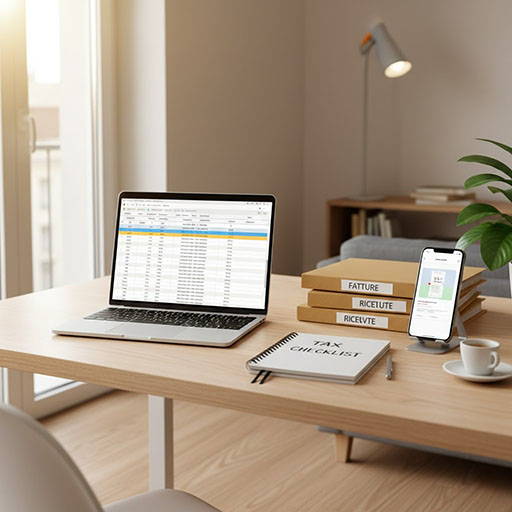
Let me share the best practices for freelance bookkeeping in Italy I learned after several painful mistakes.
Mistake #1: I didn’t separate business and personal expenses for six months. Disentangling them for my first tax return took an entire weekend. Now I use a dedicated business account.
Mistake #2: I kept receipts in a physical shoebox. One coffee spill nearly destroyed three months of records. Now everything is scanned and stored in the cloud.
Mistake #3: I procrastinated recording expenses. Trying to remember what a €43 charge was from four months ago is impossible.
Here’s my current system for how to keep records for freelance accounting:
How to track expenses for tax deductions practically: I use a simple spreadsheet with columns for date, vendor, amount, category (software, equipment, travel, education), and notes. When tax time arrives, I have everything organized.
Building consistent habits prevents year-end panic.
At day’s end (literally five minutes):
I calendar a two-hour block at month-end:
Let me clarify deductible business expenses in Italy for common freelance scenarios under regime ordinario (remember: forfettario doesn’t allow itemized deductions).
Fully deductible examples:
Partially deductible:
For remote workers: Which expenses are deductible for remote workers who work from home? If you have a dedicated workspace:
Keep meticulous records: invoices, receipts, contracts. If questioned, you need to prove the expense was necessary and exclusively for professional activity.
Going back to the difference between gross and net freelance earnings with expenses included: Say you invoice €30,000, pay €7,500 INPS, owe €4,500 income tax, but also spent €3,000 on legitimate business expenses under ordinario.
Those expenses reduce your taxable base, potentially saving you €600-900 in taxes (depending on your rate).
Here’s a quick story showing how to calculate net income after Italian taxes from yearly totals:
Last year, I invoiced €28,000 gross. I paid:
Net amount actually available for living expenses: €15,320 (about 55% of gross).
Returning to business invoices requirements in Italy from a compliance angle: beyond the mandatory fields listed earlier, you need consistent numbering. I use format “2024-001, 2024-002” etc., resetting annually.
Your volume d’affari annuo (annual turnover) must be monitored constantly if you’re under regime forfettario. I maintain a running total in my spreadsheet. When I hit €70,000 mid-year, I start watching carefully if I’m on track to exceed €85,000, I need to plan for regime change.
The limite di ricavi regime forfettario threshold matters because exceeding it kicks you out of the simplified system immediately. You’re moved to ordinario, must start charging VAT, and face significantly more accounting work potentially mid-year, which creates chaos.
If you’re approaching the limit, you have options:
I intentionally keep my revenue below €75,000 to maintain a safety buffer. The administrative simplicity of forfettario is worth capping my growth temporarily while I’m still solo.
Let me list the common tax mistakes new freelancers make in Italy that I’ve witnessed (or made myself):
Errore 1: Not registering quickly enough
Working without a partita IVA for months, then trying to retroactively register. This creates tax compliance nightmares. Fix: Register before your first invoice.
Errore 2: Mixing personal and business finances
Makes tracking income and expenses nearly impossible. Fix: Open a dedicated business account on day one.
Errore 3: Forgetting to set aside tax money
Spending every euro as it arrives, then panicking at payment deadlines. Fix: Automatic transfer of 40% of each invoice to savings.
Errore 4: Wrong codice ATECO selection
Choosing a code that doesn’t match your actual work. Fix: Research thoroughly and pick the closest match to your primary activity.
Errore 5: Ignoring INPS deadlines
Focusing only on income tax and forgetting quarterly contribution payments. Fix: Calendar all deadlines prominently.
Errore 6: Not keeping proper invoice records
Lost invoices mean you can’t prove income or verify what clients owe you. Fix: Digital filing system from invoice one.
Errore 7: Assuming forfettario expenses are deductible
Trying to deduct business costs when the regime doesn’t allow it. Fix: Understand your regime’s rules completely.
These are the errori fiscali comuni dei freelance in Italia that generate penalties, interest charges, and stress. How to avoid tax penalties as a freelancer? Build simple habits:
Here’s a personalized tax checklist for independent contractors in Italy that you can adapt to your situation:
☐ Registration phase:
☐ Monthly actions:
☐ Quarterly actions:
☐ Annual actions:
This integrates the main steps from a guida fiscale per la prima partita IVA into a practical workflow.
When circumstances change, remember to coordinate with Agenzia delle Entrate:
Do I need an accountant for my freelance activity? This question deserves a nuanced answer.
You might handle everything yourself if:
You probably need professional help if:
Regarding freelance accountant costs in Italy: expect roughly €500-1,500 annually for basic services under forfettario, and €1,500-3,000+ under ordinario. I know these numbers feel steep when you’re just starting, but view them as insurance against costly mistakes.
The difference between a commercialista and a consulente fiscale: A commercialista is a certified public accountant who can handle full accounting, tax filing, and representation before tax authorities. A consulente fiscale (tax consultant) focuses specifically on tax matters but may have different certification. For most freelancers, a commercialista provides the comprehensive service you need.
When to ask for help from a commercialista: I went three years solo under forfettario before hiring one. The tipping point came when I started invoicing French and German clients the cross-border VAT questions exceeded my comfort zone. Best decision I made.
My commercialista spotted €800 in overpaid taxes from year one that I could claim back.
What documents do I need for my first tax return? Bring your professional:
For how to file a freelance tax return in Italy: if working with a commercialista, they’ll prepare everything and explain it before submission. If filing yourself, use the Agenzia delle Entrate’s online platform with their step-by-step guide.
Come compilare la dichiarazione dei redditi da autonomo (how to fill the autonomous worker tax return): the process involves entering your income, calculating your taxable base according to your regime, applying contributions and deductions, and computing the final balance.
The official software guides you through each section.
Before issuing your first invoice, complete this cosa devo fare il primo anno da freelance planning phase:
Define your activity precisely: What services will you offer? Who is your target market? This isn’t just philosophical you’ll need this clarity for choosing codes and regimes.
Choose your codice ATECO: Use the guidance from earlier to select the code that best matches your primary activity.
Decide between regime forfettario vs regime ordinario: For most first-year freelancers with modest expected revenue, forfettario makes sense. But review your specific situation.
Estimate first-year revenue: Be realistic. This affects your contribution calculations and planning.
Return to the earlier sections on step-by-step guide to registering as a freelancer and opening a partita IVA step by step to execute registration properly.
January-March checklist:
☐ File paperwork to obtain partita IVA
☐ Receive your partita IVA number (usually within days)
☐ Set up PEC (posta elettronica certificata) from an authorized provider
☐ Register for fatturazione elettronica through invoicing software
☐ Connect to Sistema di Interscambio (SDI) through your software
☐ Determine if VAT registration for Italian freelancers applies to you
☐ Issue your first invoice with all required fields
☐ Begin tracking volume d’affari annuo from invoice one
☐ Set up your bookkeeping system (spreadsheet or software)
☐ Open dedicated business bank account
☐ Create tax savings account and start setting aside 40%
I issued my first invoice in February, exactly three weeks after obtaining my partita IVA. The relief of having everything legal and official was worth every bureaucratic hour.
April-June checklist:
☐ Calculate and pay first INPS contributions for freelancers (typically due by May 16)
☐ Learn the F24 payment system through your bank or Agenzia delle Entrate
☐ If this isn’t your absolute first year, prepare for June 30 deadline with acconto imposte and potential saldo from previous year
☐ Verify that all invoices are properly archived
☐ Check that INPS contributions are correctly recorded online
☐ Update your annual revenue projections
☐ Ensure contributi previdenziali are being tracked properly
In my second quarter of year one, I was fortunate to have no previous-year tax balance. But I did need to pay my first INPS contributions, which shocked me I hadn’t budgeted properly. Don’t make my mistake.
July-December checklist:
☐ Pay second INPS installment (typically due by August 20)
☐ Monitor your limite di ricavi regime forfettario threshold constantly
☐ If approaching €85,000, decide on strategic response
☐ Review previsioni di imposta per lavoratori autonomi at six-month mark
☐ Update your calcolo imposte per lavoratori freelance estimates
☐ Pay November acconto if required (around November 30)
☐ Plan for next year: can I change tax regime after the first year?
☐ If regime change desired, research requirements and deadlines
☐ Prepare year-end invoice summary
Mid-year reviews are crucial. I discovered in August that I was on track to hit €82,000 uncomfortably close to the limit. I adjusted my client pipeline to stay safely under.
December-January checklist:
☐ Issue final invoices before December 31
☐ Compile complete annual invoice list with totals
☐ Gather all expense receipts (if regime ordinario)
☐ Collect INPS contribution payment confirmations
☐ Download statements for all local taxes for professionals in Italy paid
☐ Prepare for addizionale regionale, addizionale comunale
☐ Calculate estimated municipal surtax on freelance income
☐ Begin tax return preparation (or schedule appointment with commercialista)
☐ Prepare documents needed for how new freelancers declare income in Italy
☐ Review the year honestly: what worked, what didn’t
This remains a guida semplice alle tasse per chi lavora in proprio, but remember: review everything with a trusted advisor before final filing. Individual situations vary, and I can only share what worked in my case.
Agenzia delle Entrate (Tax Authority):
Website: agenziaentrate.gov.it
Their site offers guides specifically for freelancers, FAQ sections explaining common scenarios, and the Fisconline area where you’ll file returns and check your tax position. I recommend creating your access credentials immediately after obtaining your partita IVA you’ll need them repeatedly.
INPS (Social Security):
Website: inps.it
Online services for gestione separata INPS let you verify contribution payments, check your pension accumulation, and manage your profile. The site requires SPID, CIE, or CNS authentication. Set this up early so you can come verificare i versamenti dei contributi INPS whenever needed.
Camera di commercio and registro imprese:
Relevant mainly if you’re registering an actual business entity beyond simple partita IVA. For most intellectual freelancers, this isn’t necessary in year one. But if you later expand into trade, retail, or certain regulated activities, you’ll interact with your local Chamber of Commerce.
Your PEC (posta elettronica certificata) becomes your official digital mailbox. I use mine for:
Regarding Sistema di Interscambio (SDI) and fatturazione elettronica: you won’t directly “use” SDI as a separate portal. Instead, your invoicing software connects to SDI behind the scenes. Every time you generate an invoice, the software formats it as XML and transmits it through SDI to your client.
For how to keep records for freelance accounting without getting overwhelmed, I recommend:
I use a free invoicing tool designed for Italian partita IVA holders. It generates compliant XML files, connects to SDI, maintains invoice numbering, and costs nothing up to a certain volume. Worth researching options based on your specific needs.
Let me bring this freelancer taxes italy checklist back together. When I started, the system felt impossibly complex a labyrinth of codes, deadlines, and obligations where one wrong turn could trigger penalties. But breaking it into small, manageable steps made everything achievable.
Here’s what actually matters:
Register properly: Open your partita IVA correctly with appropriate codes and regime choice. This foundation determines everything else.
Build saving habits: Set aside 40% of every invoice automatically. Seriously this single habit prevents 90% of tax stress.
Track consistently: Log invoices and expenses when they happen, not weeks later when memory fails.
Meet deadlines: Calendar everything. Small penalties for being a week late aren’t catastrophic, but avoiding them completely is easy with reminders.
Monitor limits: If you’re under regime forfettario, watch your annual revenue. Crossing €85,000 unexpectedly creates chaos.
Ask for help: When situations exceed your confidence level, hiring a commercialista is an investment, not an expense.
Taking small, regular actions genuinely avoids the errori fiscali comuni dei freelance in Italia and last-minute panic I see in online forums constantly. The people struggling most are those who ignore everything for eleven months, then face a crisis in June.
Treat this as a living tax checklist for independent contractors in Italy.
As your volume d’affari annuo grows, as your services expand, as your client base internationalizes revisit these sections and adapt your systems. What works for €20,000 annual revenue needs upgrading at €60,000.
You’ll know it’s time to move from DIY to professional help when:
The moment to reconsider regime forfettario vs regime ordinario arrives when:
Finally, periodic review of your overall tasse e contributi per professionisti senza albo situation makes sense every 2-3 years, even if nothing changes. Tax laws evolve, your business evolves, and opportunities appear.
My current plan: I’m staying under forfettario limits for now, but preparing systems for eventual ordinario transition. When I consistently hit €75,000+ and feel constrained by the limit, I’ll make the switch deliberately and prepared rather than being forced into it mid-year.
How does self-employment tax work in Italy? As a new freelancer, you’re responsible for two main obligations: income tax (IRPEF) and social security contributions (INPS). Together, these form what people call Italian self-employment tax rules.
When I invoice a client, the full amount doesn’t go into my pocket. From every €100 earned, roughly €15 goes to income tax (under regime forfettario) and €26 goes to INPS contributions about €41 total before local surcharges.
These aren’t withheld automatically like employee taxes; you must calculate, budget, and pay them yourself at designated deadlines throughout the year.
The IRPEF brackets for self-employed workers apply differently based on your regime choice. Under forfettario, you pay a flat 15% (or 5% in first years under certain conditions) on your taxable income after applying redditività coefficients.
Under regime ordinario, progressive brackets apply just like for employees, but you calculate and pay yourself.
Remember that contributi previdenziali (INPS contributions) aren’t really taxes they build your pension credits. While they feel like taxes when they hit your bank account, they’re mandatory retirement savings that eventually benefit you.
Always verify current rates and rules with Agenzia delle Entrate or a commercialista, as percentages and thresholds can change with annual budgets.
What is the minimum income for opening a partita IVA? There’s no legal minimum. Technically, you could open a partita IVA expecting to earn just €3,000 in a year the system doesn’t stop you.
However, practical considerations matter. Once you have a partita IVA for freelance workers, you face mandatory INPS contributions (typically around 25-26% of income, with minimum thresholds in some cases) plus administrative duties.
If your expected income is very low say under €5,000 these fixed costs might exceed your earnings.
That said, many people open a partita IVA with modest first-year expectations because:
In my case, I opened mine expecting about €18,000 in year one. That was enough to cover contributions, taxes, and basic living expenses while building my client base. By year three, I’d tripled that figure.
If you’re genuinely uncertain whether your freelance activity will generate enough income to justify the partita IVA costs, consider working initially under occasional collaboration contracts (ritenuta d’acconto arrangements) until your revenue stabilizes. Then transition to partita IVA when the numbers make sense.
The question “how much to set aside for taxes each month” kept me awake before my first June deadline. Based on regime forfettario with typical freelance activities, I recommend setting aside 40% of every invoice.
Here’s my breakdown:
When I invoice €1,000, I immediately transfer €400 to my tax savings account. That account stays untouched except for making actual tax payments. Over a year earning €30,000, I accumulate about €12,000 in savings which roughly covers my actual obligations.
This approach is slightly conservative. You might end up with a small surplus, but that’s far better than owing money you’ve already spent. The surplus becomes working capital for slow months or gets reinvested in your business.
Using previsioni di imposta per lavoratori autonomi spreadsheets helps refine this percentage for your specific situation. Factors like your codice ATECO (which affects coefficienti di redditività) and whether you have other income sources influence the exact figure.
For calcolo imposte per lavoratori freelance planning, track your running total monthly. By mid-year, you’ll have a clearer picture of actual obligations and can adjust your savings rate if needed.
Do freelancers pay VAT on all invoices? The answer depends entirely on your tax regime. This confused me initially because the rules differ dramatically.
Regime forfettario: You typically do NOT charge IVA on invoices. Your invoices state the service provided and your fee, without adding the standard 22% VAT. You must include a note explaining the VAT exemption based on regime forfettario legislation. This keeps your pricing simple what you quote is what the client pays.
Regime ordinario: You MUST charge VAT at the applicable rate (usually 22% for services). If you quote €1,000 for a project, your invoice shows €1,000 + €220 VAT = €1,220 total. You collect that €220 on behalf of the government and remit it through VAT returns.
Regarding VAT registration for Italian freelancers: under ordinario, you’re automatically registered for VAT when you open your partita IVA. Under forfettario, you operate outside the VAT system.
How often do I need to file VAT returns in Italy? Under ordinario, typically quarterly or annually based on turnover volume. Under forfettario, you don’t file VAT returns at all you’re exempt from this requirement.
One exception: if you provide services to EU businesses, special VAT rules apply even under forfettario (reverse charge mechanism). Foreign transactions add complexity that I’d recommend discussing with Agenzia delle Entrate or your commercialista.
Learning how to pay INPS contributions online took me several frustrated attempts before I figured out the workflow. Here’s the step-by-step process:
To pay:
Alternatively, use the Agenzia delle Entrate website to generate and pay F24 forms directly.
To come verificare i versamenti dei contributi INPS (verify contribution payments are recorded):
I check this quarterly after making each contribution payment. Errors do occur payments sometimes get misclassified or lost in the system. Catching problems immediately is far easier than discovering them three years later.
The INPS contributions for freelancers portal also shows your accumulated pension credits over time. It’s sobering and motivating to see those numbers build. While contributions feel painful when paid, seeing your pension position grow reminds you these aren’t just thrown-away money.
If you spot an error or missing payment, contact INPS immediately through their help desk or your commercialista. They can investigate and correct the record.
What happens if I miss a tax deadline in Italy? I experienced this once when I was traveling and forgot about a November deadline. Here’s the reality:
Minor delays (days to weeks): You can use “ravvedimento operoso” (voluntary correction) to pay late with reduced penalties. The penalty percentage increases based on how late you are roughly 0.1% per day initially, then escalating if you wait months. For a €1,000 payment one week late, expect around €7-10 in penalties.
Major delays (months): Penalties escalate significantly, and you might receive formal notices from Agenzia delle Entrate. These can include interest charges and potentially formal assessment procedures.
To fix a missed deadline:
How to avoid tax penalties as a freelancer? Build these habits:
Regarding underpayment (paying too little rather than too late): when you file your annual return, any underpayment gets calculated automatically. You’ll pay the difference plus interest. The system is designed to eventually reconcile everything but proactive accuracy avoids these adjustments.
Which expenses are deductible for remote workers working from home or co-working spaces? This depends heavily on your tax regime, which I learned after initially confusing the rules.
Under regime ordinario (ordinary regime):
Fully deductible business expenses in Italy include:
Partially deductible:
Under regime forfettario:
Here’s the catch: you CANNOT itemize deductions. The coefficienti di redditività built into the system already assume average business costs. Even if you spend €10,000 on equipment, you can’t deduct it individually. The flat-rate system trades deduction capability for simplicity.
Tax tips for digital nomads in Italy specifically: if you’re location-independent and work across Italy or Europe, keep every receipt regardless of regime. If you later switch to ordinario, you’ll want that expense history. Also, track your physical location carefully tax residency depends on where you spend most time (>183 days).
Pro tip from my experience: even under forfettario where expenses aren’t deductible, tracking them helps you understand your true profit margins and price your services appropriately. I know my actual net income after business costs, even if tax calculation ignores those details.
Do I need an accountant for my freelance activity? This question deserves an honest answer because freelance accountant costs in Italy feel significant when you’re earning €20,000 annually.
You can likely manage alone if:
Consider hiring a commercialista if:
When to ask for help from a commercialista: I went solo for three years, then hired one when I landed my first French client and had no idea how to invoice properly under EU rules. That decision paid for itself immediately my commercialista identified errors in my previous returns that generated a €800 refund.
Realistic freelance accountant costs in Italy:
A commercialista handles your entire modello Redditi PF preparation, calculates all obligations accurately, files electronically, and explains everything in plain language. A consulente fiscale (tax consultant) focuses specifically on tax strategy and optimization.
Consider the investment this way: if a commercialista saves you one penalty, identifies one missed deduction, or prevents one year of incorrect contributions, they’ve likely paid for themselves. Peace of mind alone justifies the cost for many people.
Can I work with foreign clients as an Italian freelancer? Absolutely I do this regularly and it’s perfectly legal. However, invoicing and tax reporting differ from domestic work.
For EU business clients (B2B): Apply the “reverse charge” mechanism. You invoice without Italian VAT, noting that VAT is due in the client’s country under reverse charge rules. Include both your and their VAT numbers on the invoice. Under regime forfettario, you’re outside the VAT system anyway, so note your exemption basis.
For non-EU clients: Generally, you invoice without Italian VAT (services are considered provided where the client is located). Check specific rules based on service type.
Platforms and marketplaces: How to declare income from platforms and marketplaces like Upwork, Fiverr, or app stores requires careful tracking. These platforms often:
You must still report this income when filing Italian taxes. Include the full amount earned (before platform fees) in your revenue calculation. Keep detailed records of:
To report freelance income to the tax office from abroad: include all foreign earnings in your annual return under the same categories as domestic work. If the platform withheld foreign taxes, you might be able to claim credits to avoid double taxation (complex topic definitely consult a commercialista for this).
Local taxes for professionals in Italy apply to worldwide income for Italian tax residents, regardless of where your clients are located or where money comes from.
One key challenge with platforms: they don’t withhold Italian INPS contributions or income tax. You must calculate and pay these yourself based on total platform earnings, just like domestic work.
Here’s my simplest possible guida semplice alle tasse per chi lavora in proprio in Italy the absolute essentials:
Before starting: ☐ Open partita IVA using the opening a partita IVA step by step process outlined earlier ☐ Choose appropriate codice ATECO ☐ Select regime forfettario (recommended for most beginners) ☐ Set up PEC (certified email) ☐ Open dedicated business bank account and tax savings account
Every invoice: ☐ Issue proper electronic invoice through Sistema di Interscambio ☐ Log it in your tracking spreadsheet ☐ Transfer 40% of payment to tax savings account when received ☐ Update running total of annual revenue
Quarterly (every 3 months): ☐ Pay INPS contributions by relevant deadline ☐ Verify payments recorded correctly on INPS website ☐ Review progress toward €85,000 revenue limit if under forfettario
June deadline: ☐ File annual tax return (modello Redditi PF) ☐ Pay saldo imposte (balance from previous year, if applicable) ☐ Pay first acconto imposte (40% of current year estimate)
November deadline: ☐ Pay second acconto imposte (60% of current year estimate)
Continuously: ☐ Keep all invoices and receipts filed and accessible ☐ Monitor tax deadlines calendar ☐ Check for updates to rules from Agenzia delle Entrate ☐ Plan for previsioni di imposta per lavoratori autonomi quarterly
This covers the core cycle. Everything else learning about coefficienti di redditività, understanding addizionale comunale variations, optimizing deductions builds on these foundations.
The errori fiscali comuni dei freelance in Italia almost always come from skipping these basics: not registering properly, not saving for taxes, missing deadlines, or failing to track income accurately.
Start with this checklist, gradually deepen your knowledge, and don’t hesitate to upgrade to professional help when your situation warrants it.
Final thoughts: This article represents my genuine first-year freelance tax experience in Italy. Every mistake mentioned, I made. Every system described, I use. Tax rules change periodically, individual situations vary enormously, and this guide cannot replace professional advice for your specific circumstances. Always verify current regulations with Agenzia delle Entrate or a qualified commercialista before making important decisions.
But I hope this guide gives you the confidence to start, the knowledge to avoid my mistakes, and the framework to build your own successful freelance tax system in Italy.
Good luck with your freelance journey!
Author: Tonny Robinson – Tonny is a freelance consultant who has navigated the Italian tax system from scratch and shares practical, real-world insights for new independent workers.
Published by: Ahmed Saeed