
Madrid Airport Express Bus: Atocha by Day, Cibeles at Night
- November 8, 2026
- 0
The Madrid Airport Express bus runs around the clock, but its last city stop changes. In the daytime you can ride from Barajas Airport to Atocha railway station.

The Madrid Airport Express bus runs around the clock, but its last city stop changes. In the daytime you can ride from Barajas Airport to Atocha railway station.
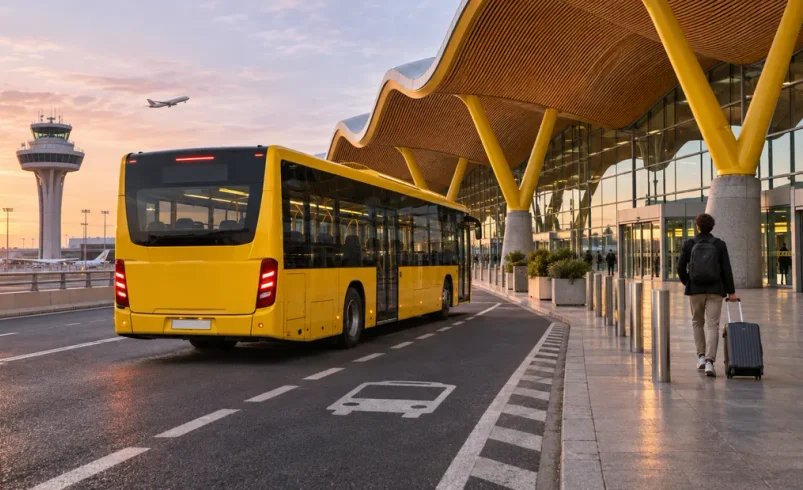
The Madrid Airport Express bus runs around the clock, but its last city stop changes. In the daytime you can ride from Barajas Airport to Atocha railway station. At night the bus finishes at Plaza de Cibeles. If your hotel confirmation says “Atocha,” or you have a train to catch there, check the destination on the bus before loading your suitcase.
Start with the time you expect to reach the bus stop, your arrival terminal and the street address where you need to end up. A flight landing late in the evening can look like a daytime connection on paper and turn into a night-bus journey by the time your bag arrives. Here is how to choose the right stop and plan the part of the trip beyond it.
A search for “Madrid airport to city centre” gives you a starting point, but central Madrid is too large to treat as a single destination. Enter your hotel’s street address in a map, then compare the walk from O’Donnell, Cibeles and, for a daytime arrival, Atocha. Use the actual hotel entrance. A short-looking route to the centre of a neighbourhood can leave you on the wrong side of a park or a busy road.
Read the station name on your rail ticket first. If it says Madrid Puerta de Atocha, the daytime express can take you to the station area. If it says Madrid Chamartín, staying on the bus until Atocha takes you to a different station. Showing someone the ticket is more useful than asking for “the train station.”
Allow time between stepping off the bus and reaching the departure area. You still have to enter the station, find the correct concourse and follow your operator’s boarding instructions. For a fixed train, work backwards from the time you need to be at boarding. A map estimate ending at the pavement outside Atocha leaves out the part where a first-time visitor is most likely to hesitate.
Cibeles works well when the walk from the square is manageable with your actual luggage. Two travellers sharing one small case may make a different choice from two travellers each carrying a checked bag and a cabin bag. Look up the route from the bus stop to the door before deciding that a hotel described as “near Gran Vía” is close enough.
If you are staying near Retiro, compare O’Donnell with Cibeles. The name of the park alone cannot tell you which stop to use. A room close to one entrance can be a much longer walk from another. Put both walking routes side by side. Look for road crossings, the location of your entrance and whether the route depends on walking through the park at your arrival time.
After collecting your luggage, look for the airport’s bus signs and the stop marked Exprés Aeropuerto. Confirm the route and destination on the vehicle or stop display. Several buses serve Barajas. A bus heading towards Avenida de América, for example, takes a different route and will not drop you at the daytime express terminus.
At T1, T2 or T4, start with the express stop for the terminal you are in. There is little point moving to a different terminal simply because a travel article illustrates its stop. If you arrive at T3, follow the airport’s directions towards the appropriate T2 bus stop. At T4S, follow the arrivals route through to the main T4 building before looking for the public bus. Allow for this movement when estimating the time you will reach the kerb.
For precise stop locations, use EMT Madrid’s airport route maps and timetable. The page includes several airport buses. Look for “Exprés 203” and select the direction you intend to travel. On Spanish signs, salidas means departures and llegadas means arrivals. Those words describe airport areas. The name on the front of the bus tells you where the bus is going.
The simplest option for a first trip is to pay as you board. Madrid’s tourism office lists contactless bank cards, mobile payment and cash. If paying cash, bring small notes. The tourism office says drivers do not accept notes larger than €20. Have your payment method ready before moving a suitcase onto the bus, especially if you also need a free hand for a child or a second bag.
There is a small discrepancy worth knowing about. EMT’s airport information lists €5, while Madrid Tourism’s Airport Express guide lists €5.10. Budget for the higher figure and check the amount shown when buying. Carrying a contactless card or some change is easier than arriving with precisely one €5 note. The price of an ordinary city bus ride is a poor guide to the express fare.
Use the luggage space and keep the aisle clear. Before putting a large bag away, take out the things you need at the stop: your phone, hotel address and, if you have an onward journey, your train ticket. If several cases look alike, remember a distinguishing detail. Getting off at O’Donnell is easier when you can identify your case without lifting someone else’s.
Think of Cibeles as the start of a second journey. The night service still connects the airport with central Madrid, but it does not continue to Atocha. The distinction matters most for travellers arriving near the changeover. A published time at one end of a route does not tell you when the last daytime vehicle passes every other stop.
If the destination display is unclear, ask the driver, “¿Este autobús llega a Atocha?” That means “Does this bus go to Atocha?” If the answer is “solo hasta Cibeles,” the bus goes only as far as Cibeles. You can still take it if you have a workable onward route.
Before boarding, save the hotel address and an offline view of the streets around it. Then choose the rest of the journey. Walking can work for a nearby hotel. A connecting night bus can suit a longer distance if its stop, direction and departure line up. A taxi can make more sense if the second leg involves a long wait or several bags. For two or more people, compare the whole group’s bus fares plus the onward ride with a direct quote from the airport.
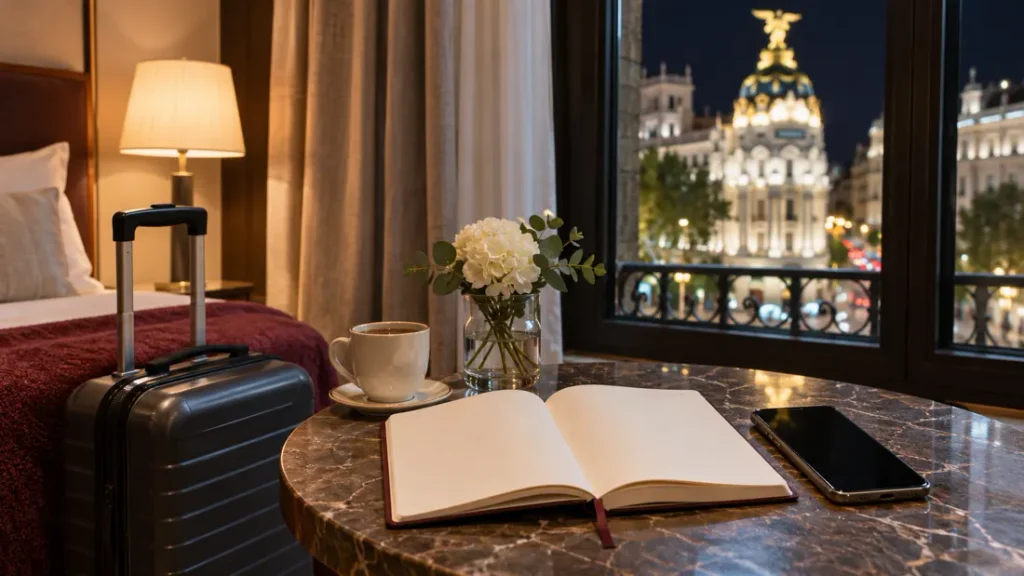
Imagine your flight lands at 23:10 and your accommodation is near the station. You have a checked bag. It would be optimistic to make a plan that succeeds only if you exit the aircraft, collect the case and reach a particular daytime service almost immediately. Save two routes before departure: the daytime ride to Atocha, and the night ride to Cibeles followed by a trip to your door. At the stop, the bus destination tells you which plan you are using.
EMT gives reference driving times from Atocha of about 30 minutes to T1, 35 to T2 and 40 to T4 in normal traffic. These figures describe the drive in the stated direction. They leave out the wait at the stop and the walk inside the airport. Treat them as a way to compare terminals when planning your return, especially if the flight confirmation simply says “Madrid.”
Consider an example. You reach Atocha just as a daytime airport bus leaves and are heading to T4. A wait of about 20 minutes followed by a roughly 40-minute ride already takes an hour, before you walk to check-in. Road traffic could add more. Use your airline’s airport arrival guidance as the end of your calculation. Count back through the terminal walk, bus ride, likely wait and the time it takes you to reach the stop.
The same approach works for an incoming flight and a rail connection, with the pieces reversed. Add time for disembarking, any arrival formalities, baggage, the bus stop, the road journey and the station. If the only connection you can book relies on every part going smoothly, consider a later train or a ticket with change conditions that suit you.
For a pre-dawn departure, look up the night express from Cibeles. A daytime map pin at Atocha can put you at the wrong end of an empty route. Search for the airport-bound stop, open its stop details and compare the direction on the display with your terminal. Pin that stop separately from the square itself. Cibeles is a place name shared by several stops, which matters when you are arriving on foot with only a few minutes to spare.
The evening before, walk to the stop if you are staying nearby or save the route from your hotel entrance. Check the date as well as the time. A departure at 04:00 on Friday belongs to Friday morning even if you think of it as Thursday night. Madrid Tourism also flags reduced service on 24, 25 and 31 December and 1 January. Recheck departures for your actual date if you are travelling over the holidays.
For more trip planning, visit Bravlo’s Hidden Europe Journeys travel section.
The overnight service ends at Plaza de Cibeles. If you need Atocha, plan a second leg from there or compare a direct alternative. Near the changeover, read the destination on the vehicle and ask the driver before boarding.
Yes. The express has space for luggage. Keep travel documents and small valuables with you, and place the case where it leaves the aisle clear. If you are carrying unusually large equipment, check the operator’s conditions before relying on the service.
EMT lists T1, T2 and T4 for the express. From T3, follow airport signs towards the T2 stop. Some other airport bus routes show T3 in their stop lists, so check the route number as well as the terminal name.
Yes. Madrid Tourism lists on-board payment by contactless bank card, mobile payment or cash. You can board without first finding a machine to buy a reusable city transport card. Check the displayed express fare and keep a backup payment method handy.
Compare the walking route from Cibeles and O’Donnell to the exact address. With luggage, a direct pavement route to the correct side of the park may be more useful than the shortest line on the map.
Check the next live departure and compare it with your airline’s check-in or bag-drop deadline. EMT lists a typical overnight interval of around 35 minutes. If waiting would use up your margin, price a direct ride before committing to another wait.
Ahmad Hassan is the founder and editor-in-chief of Bravlo.eu. He works with the editorial team on European travel guides that help readers make decisions before they leave home. For this guide, the focus is on the details that change a Madrid arrival: the terminal on the boarding pass, the destination on the bus and the distance from the final stop to the hotel door.